
How To Optimize Content For Google AI Overviews (2026 Guide)
You publish a strong piece of content. It ranks well. You even sit comfortably in the top three.
Then you search for the topic yourself.
And before anyone clicks anything, Google answers the question for them.
Not with your page. With an AI-generated summary…
That moment is becoming familiar as we head into 2026.
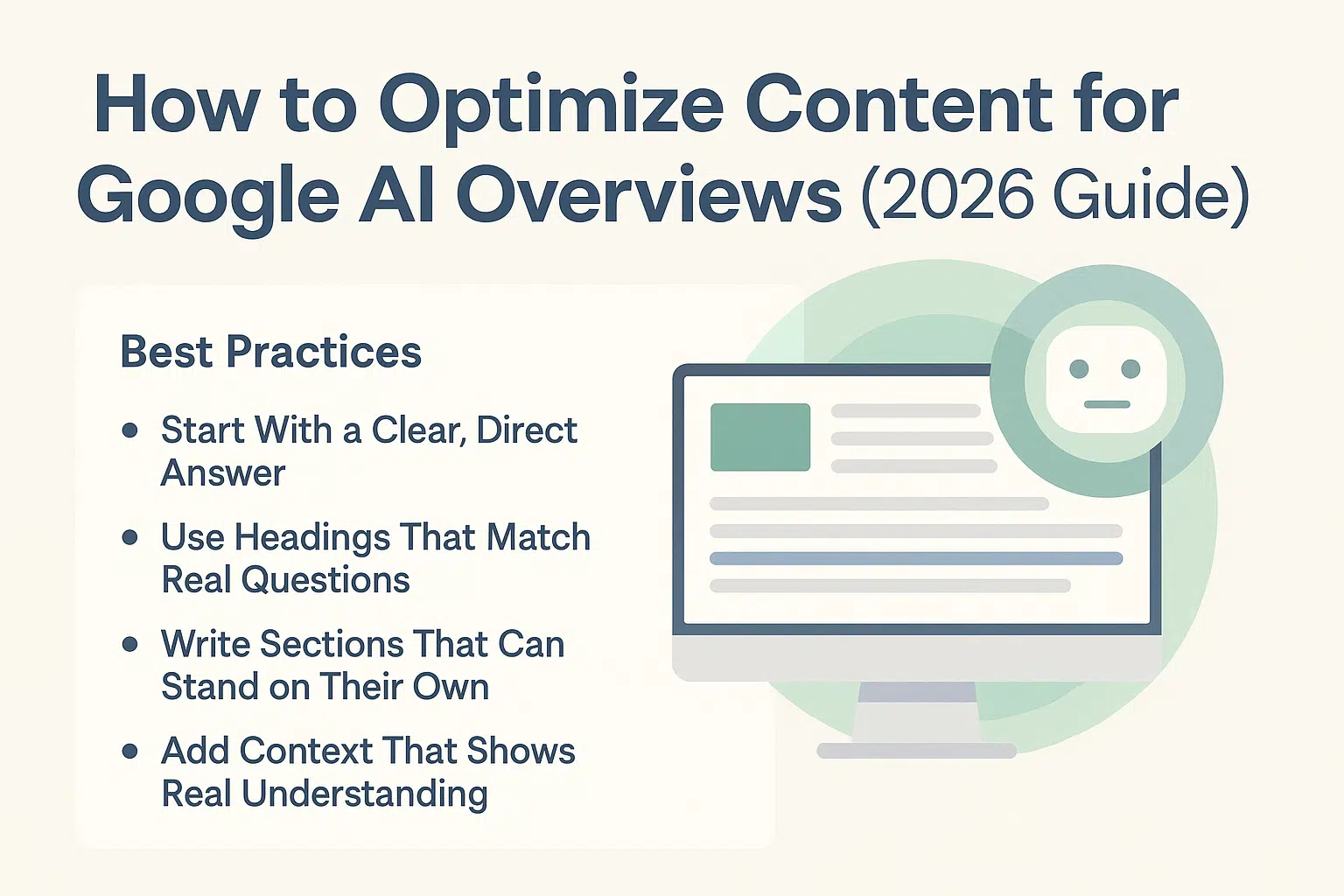
Google AI Overviews now reach more than 2 billion users every month. Roughly 30 percent of searches already trigger an AI Overview, and that number keeps climbing. On desktop searches in the U.S. alone, AI Overviews now appear for about 16 percent of keywords, up from single digits just months earlier.
Here is where it starts to hurt.
This is not about chasing algorithms. It is about understanding AEO vs SEO and why Google now values reusable answers over ranked pages. It is choosing which sources it trusts enough to reference. And that decision often happens before a user ever sees the traditional search results. Ranking still matters, but visibility now depends on whether your content is clear, useful, and easy for Google to understand and reuse.
This is not a sudden change for us.
At Logic Inbound, we have been testing how content is discovered, indexed, and surfaced long before AI Overviews became mainstream. As early as 2021, we ran controlled content experiments to understand how different formats affected indexing, engagement, and growth. One such project grew from roughly 30 users per day to over 150 users per day in six months, not because the content was automated, but because it followed a consistent structure, answered specific questions, and matched real search intent.
That experience taught us something important that still applies today. If you want to understand how Google is actually using your content in AI Overviews, call us on (206) 800-7756 or email sa***@**********nd.com. We’re ready to help businesses overcome all challenges!
This guide is about applying that lesson to Google AI Overviews.
You will learn how to structure content so Google can easily extract answers from it, why some pages get chosen even without top rankings, and the mistakes that quietly block otherwise good content from ever being referenced. No shortcuts. No hype. Just practical guidance based on how search actually works going into 2026.
If you want your content to be chosen, not just published, this is where the shift begins.
Key Takeaways
|
What Are Google AI Overviews And How Do They Work In 2026?
Google AI Overviews are short, AI-generated summaries that appear at the top of search results for certain queries. Instead of showing only a list of links, Google now tries to answer the question directly by pulling information from a small group of sources it considers clear, trustworthy, and useful.
In simple terms, Google is no longer just asking,
“Which page should rank first?”
It is also asking,
“Which pages explain this best?”
That difference matters.
In 2026, AI Overviews usually appear for searches where Google believes the user wants understanding, not browsing. These are often longer questions, comparison-style queries, or searches that start with words like how, what, why, or best. When this happens, Google’s system scans multiple pages, extracts key points, and blends them into a single summary.
Your content does not need to be the longest page on the internet to be used. It needs to be the clearest.
How Google Builds An AI Overview
Google is not guessing. And it is not making things up.
When an AI Overview appears, Google is doing what it has always done, just faster and more visibly. It looks across the web for pages it already trusts and asks a simple question: Which ones explain this clearly enough to reuse?
What has changed is how often this happens.
Recent research looking at hundreds of thousands of searches shows that AI Overviews now appear in around 13 percent of searches worldwide. That number keeps rising, especially for longer, question-based searches. In plain terms, when someone asks a real question instead of typing a short keyword, Google is more likely to step in and summarise the answer for them.
Here is the process, without the technical noise:
-
- Someone searches for a question.
- Google figures out what they are actually trying to understand.
- It scans pages it already considers reliable.
- It looks for short sections that answer the question clearly.
- It combines those sections into a single overview.
This is why some pages show up even when they are not ranked first.
Google is not just rewarding authority here. It is rewarding clarity.
-
- If your answer is buried halfway down the page, it gets ignored.
- If the content circles the topic without answering it, it gets skipped.
- If the explanation is clear and easy to lift, it gets used.
That is the quiet shift happening behind AI Overviews. Google is still reading pages. It is just far less patient than it used to be.
Why Some Pages Are Chosen And Others Are Ignored
Many pages fail to appear in AI Overviews for very basic reasons.
-
- The answer is buried too far down the page.
- The content talks around the question instead of answering it.
- The language is vague or overly promotional.
- The page assumes the reader already understands the topic.
- From Google’s point of view, that content is hard to reuse.
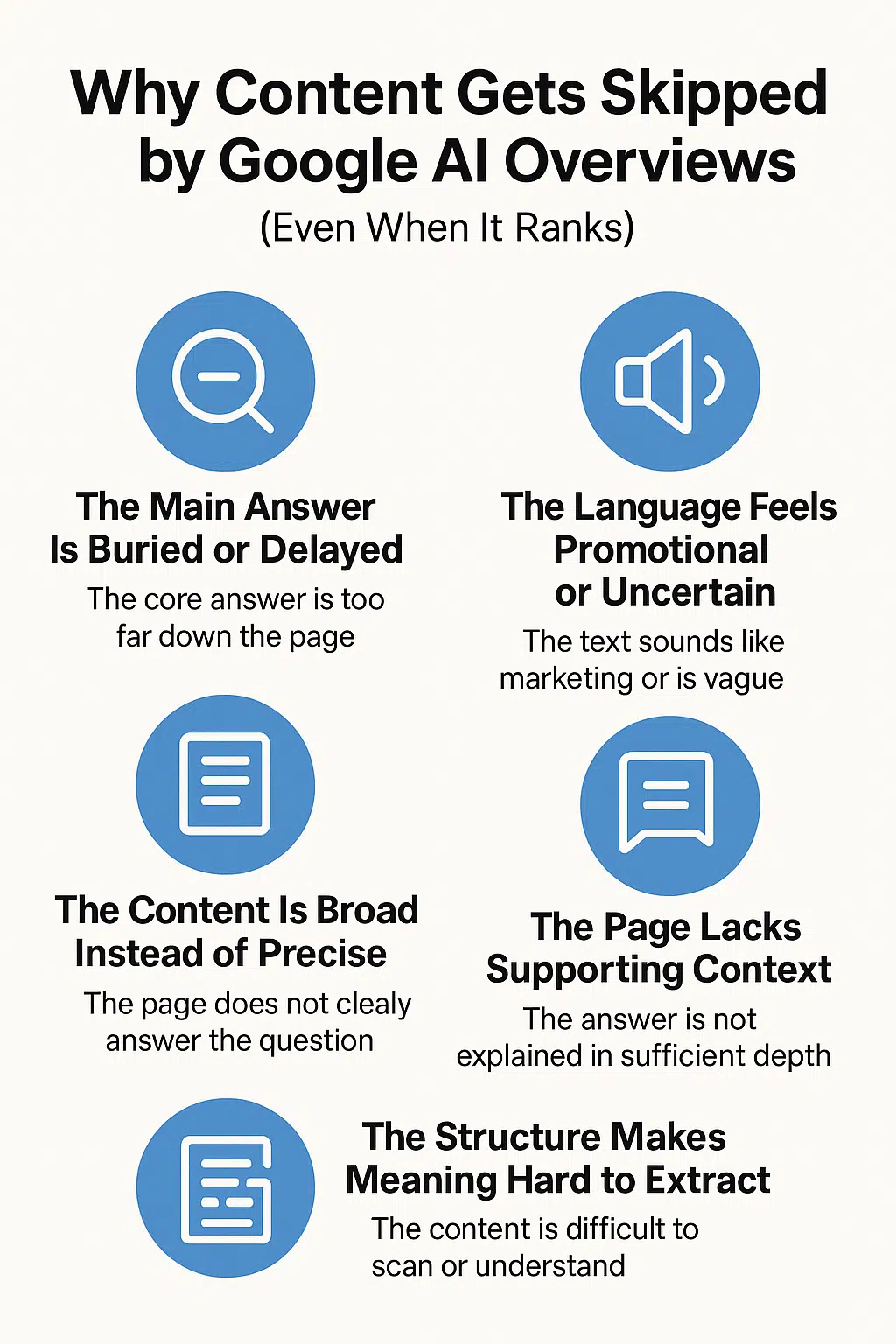
Pages that perform well in AI Overviews tend to do a few things consistently. They answer the main question early. They use simple language. They break information into clear sections. They explain ideas the way a human would explain them to another human.
This does not mean writing shallow content. It means writing organised content.
AI Overviews Are Not Replacing SEO
This part is important. AI Overviews do not replace search engine optimization. They sit on top of it.
Google still relies on SEO signals to understand which pages are credible enough to analyse in the first place. If your site has weak foundations, AI Overviews will not save it. But once those foundations exist, how your content is structured becomes the deciding factor.
Think of SEO as earning Google’s attention. AI Overviews decide how that attention is used.
That is why optimizing content for AI Overviews in 2026 is less about tricks and more about presentation.
Want Your Content To Be Chosen, Not Just Ranked?
AI Overviews don’t reward effort. They reward clarity.
We’ll review how your answers are presented, how well they match intent, and what small changes can improve AI visibility without rewriting everything.
How Does Google Choose Which Websites To Feature In AI Overviews In 2026?
Google does not “pick favourites” when it creates AI Overviews. What it does instead is look for content that makes its job easier. In 2026, that job is simple in theory but hard in practice: help users understand something as quickly and clearly as possible.
When Google decides which websites to feature, it is not asking which page is the longest or which brand is the loudest. It is asking which page explains the topic in a way that can be trusted and reused without confusion.
Here is what that looks like in real terms.
1. Google Looks For An Answer It Can Use Immediately
The first thing Google checks is whether the page answers the question clearly. Not eventually. Not after scrolling. Right near the top.
If someone searches a question, Google wants to see a response that feels complete on its own. Pages that warm up slowly, over explain, or talk around the topic usually get skipped. It is not because the content is bad. It is because the answer is hard to extract.
Clear answers help users. They also help Google understand what the page is actually about.
2. Google Prefers Content That Is Easy To Scan
Google reads pages the same way most people do. Quickly.
Content that is broken into clear sections, uses simple headings, and keeps paragraphs short is easier to understand. When ideas are grouped logically, Google can see where one explanation ends and the next begins.
This does not mean your content has to be short. It just needs to be organised. When everything blends together, meaning gets lost. When structure is clear, meaning stands out.
3. Google Pays Attention To How Confident The Content Feels
Google does not measure confidence the way humans do, but it can detect when content sounds uncertain or generic.
Pages that explain things clearly, use examples naturally, and stay consistent across the site tend to feel more trustworthy. Pages that repeat surface-level statements or rely on vague claims often do not.
You do not need complex language to show expertise. In fact, simple explanations often signal deeper understanding.
4. Google Matches Content To The Question, Not Just The Topic
One of the most common mistakes is writing content that is broadly related but not tightly focused.
If someone asks how something works, Google wants an explanation. If they are comparing options, Google wants clarity. If they are deciding what to do next, Google wants guidance.
Pages that try to cover too much often miss the mark. Pages that focus on answering one clear question tend to perform better in AI Overviews.
Best Practices To Improve Visibility In Google AI Overviews (2026)
Google AI Overviews are built to save users time. The content that gets featured is content that respects that goal.
When your page answers a question clearly, is easy to follow, and feels genuinely helpful, you are already aligned with how Google chooses sources. You are not optimizing for AI. You are optimizing for understanding.
Once Google understands what your page is about, the next question becomes simple.
Can it use your content without guessing?
In 2026, appearing in Google AI Overviews is less about writing more content and more about writing content that is easy to extract, verify, and summarise. That comes down to structure.
Here is what that looks like in practice.
1. Write Content That Is Answer-Focused, Not Just Search-Focused
Traditional SEO content is often written to rank first and explain later. AI Overviews flip that order.
Google’s systems look for pages that answer the main question clearly and early, then support that answer with context. If the page only hints at the answer or spreads it across multiple sections, it becomes difficult to reuse.
A helpful way to think about this is simple.
If someone copied one short paragraph from your page, would it still make sense on its own?
Pages that perform well usually follow this pattern:
-
- A direct answer near the top
- Clear explanation immediately after
- Supporting details further down the page
This makes the content usable for both people and AI systems.
2. Use Question-Based Headings That Match Real Search Intent
Google often treats headings as anchors when generating AI responses. Headings that reflect real questions give Google clear signals about what each section answers.
Instead of vague headings, use language that mirrors how people actually search. Long-tail questions work well because they remove ambiguity and align closely with intent.
When headings clearly state the question, the content beneath them becomes easier to identify, extract, and summarise.
3. Make Your Content Contextually Complete
AI Overviews favour pages that fully address the topic, not pages that touch on it briefly.
This does not mean covering everything in one place. It means answering the main question and the most obvious follow-up questions a user would have.
Content that feels incomplete forces Google to look elsewhere. Content that provides a full explanation in one place becomes a stronger candidate to reference.
4. Support Claims With Clear Evidence And Experience
Google is cautious about what it reuses. Content that makes claims without support is harder to trust.
Strong pages often include:
-
- Simple explanations backed by real examples
- References to established practices or sources
- Case studies or firsthand experience where relevant
- Clear language that avoids exaggeration
You do not need to overload a page with data. You do need to show that the information is grounded in reality.
5. Use Structure And Markup To Reduce Ambiguity
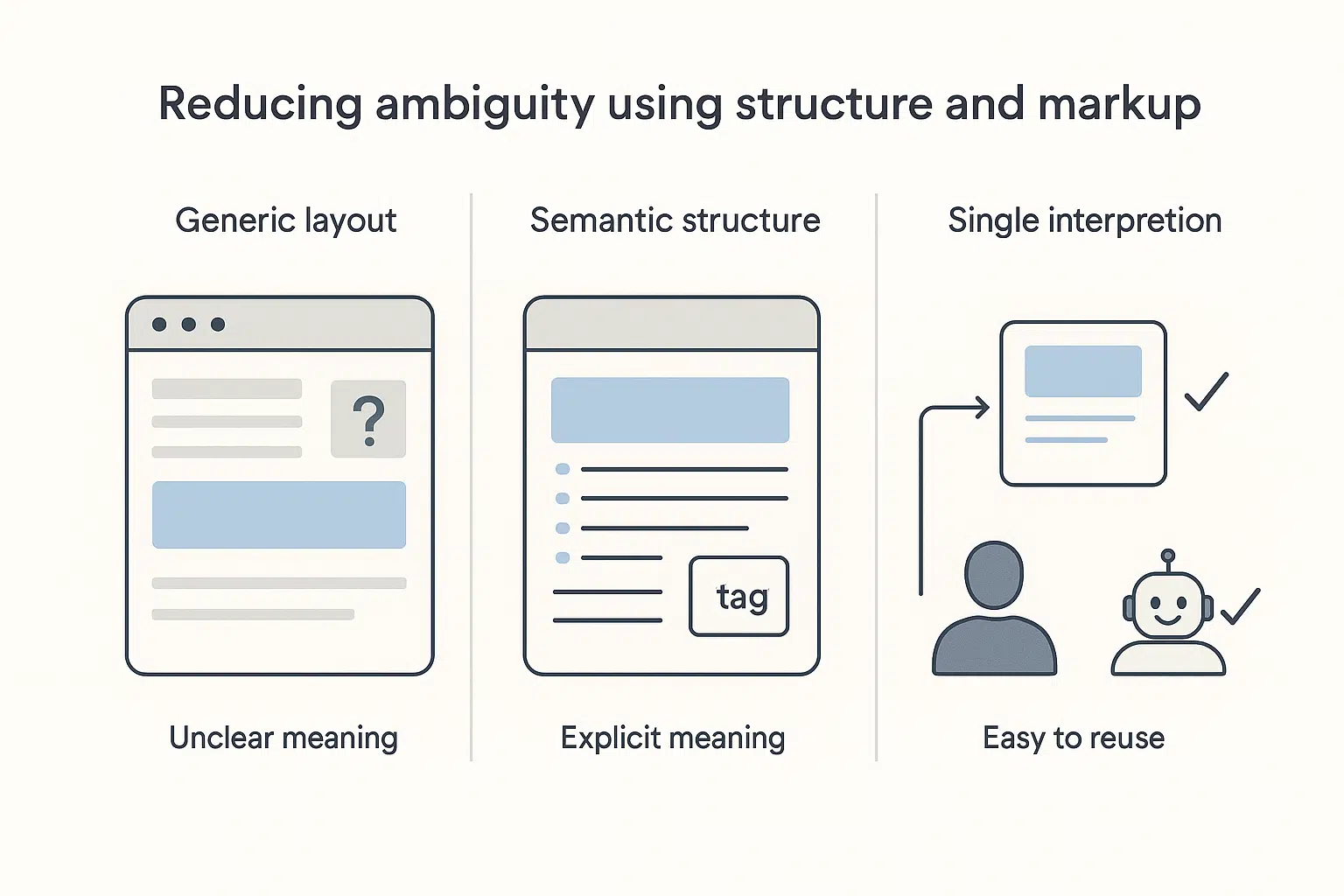
While content quality comes first, technical structure still matters.
Clear headings, logical sections, and where appropriate, structured data such as FAQ or article markup help Google understand how information is organised. This does not guarantee inclusion, but it reduces uncertainty.
When Google has to guess what a section means, it is less likely to use it. When meaning is obvious, reuse becomes safer.
Ready To Improve Your Visibility in Google AI Overviews?
Ranking is only the starting point. Find out whether your content is clear enough for Google to reuse and where simple structure fixes can make a real difference going into 2026.
Does Ranking Still Matter For Google AI Overviews In 2026? Let’s Be Clear
The real question is not whether ranking still matters.
It’s whether ranking alone is enough.
Here’s the honest answer. If your content cannot be clearly understood and reused, rankings will only take you so far. And if your content is clear but your SEO foundation is weak, AI Overviews will never even see it.
So no, this is not a choice between traditional SEO and AI visibility. It’s about understanding where you are right now and adjusting accordingly.
-
- Starting from scratch or struggling to rank? Focus on strengthening your SEO foundation first.
- Already ranking well but losing visibility to AI summaries? Improve how your content is structured, explained, and prioritised.
- Somewhere in between? That’s where most businesses are. And that’s where small changes often deliver the biggest gains.
At Logic Inbound, we’ve been working with content discovery long before AI Overviews became part of everyday search. From early content structure experiments to real-world growth projects, we’ve seen the same pattern repeat itself. Content that is clear, focused, and written with intent gets surfaced. Content that relies on rankings alone slowly fades from view.
Want To Know How Your Content Is Performing Right Now?
If you’re unsure whether your pages are positioned to appear in Google AI Overviews, we can help you find out. We’ll look at how your content is structured, where clarity breaks down, and what small adjustments could improve visibility going into 2026.
Call us on (206) 800-7756 or email sa***@**********nd.com to schedule a strategy session.
No pressure. No generic audits. Just a clear assessment of where you stand and what makes sense to do next.
Frequently Asked Questions About Google AI Overviews (2026)
1. How does Google choose content for AI Overviews?
Google selects content that answers the question clearly, matches search intent closely, and is easy to extract. Pages with clear structure, direct answers, and trustworthy explanations are more likely to be featured than pages that rely on rankings alone.
2. Do I need to rank first to appear in Google AI Overviews?
No. While rankings help Google discover content, AI Overviews often feature pages that are not in the top position. Clarity, relevance, and how well the content explains the topic matter more than ranking alone.
3. Does writing for AI Overviews negatively impact SEO?
No. Writing clearly for AI Overviews often improves SEO. Content that is structured, intent-focused, and easy to understand tends to perform better for both traditional rankings and AI-generated summaries.
4. Will AI Overviews reduce website traffic?
In some cases, yes. AI Overviews can reduce clicks for certain queries. However, they also increase brand visibility and influence decisions earlier in the search journey, even when users do not click through.
5. Are AI Overviews replacing traditional SEO?
No. AI Overviews build on traditional SEO rather than replacing it. Strong SEO foundations help Google trust and analyse your content, while AI Overviews decide how that content is presented and reused.